

Please ensure Javascript is enabled for purposes of website accessibility

Applications | Production Automation | Complex Consumable Assembly

Additive manufacturing for volume production

Production-ready additive manufacturing demands consistent print quality to deliver reliable end part tolerances and material properties. Ascential™ engineers platforms that improve unit-to-unit performance and reliability, such as:

  • Industrial 3D Printing and Additive Manufacturing Systems
  • Multi-Material Deposition and Printing Platforms
  • Stereolithography (SLA) and Digital Light Processing (DLP) Systems
  • Powder Bed Fusion and Selective Laser Sintering Platforms
  • Binder Jetting and Material Jetting Systems
  • Print Head and Deposition Subsystem Development
  • Extrusion-Based Additive Manufacturing Systems
  • Production-Scale Additive Manufacturing Equipment
  • Desktop to Industrial-Scale Build Volume Platforms

Get Your 15-Minute Consultation

Solutions

Leverage precision systems & custom engineering solutions

Ascential delivers systems that production technicians can operate and replicate without supplemental engineering support. We design platforms to meet your print quality standards and calibration procedures, as well as for all pertinent regulatory and performance standards.

Additive Manufacturing Platform Development

Design complete production platforms that integrate all precision motion, material handling, and thermal management systems.

Print Head & Deposition Subsystem Development

Achieve repeatable deposition with print heads characterized for resolution, deposition rate, uniformity, and material compatibility.

Precision Motion & Gantry Systems

Maintain print quality with high-accuracy multi-axis positioning, stage design, and motion control to meet the platform's required speed, resolution, and build volume.

Manufacturing Process Development

Streamline transfer to production with tolerance analysis and process development for precision mechanical assemblies and systems-engineered workflows.

Volume Manufacturing

Scale production with closed-loop process controls for motion alignment, thermal calibration, and print subsystem performance.

Sustaining Engineering & Cost Optimization

Reduce cost per unit and improve reliability through yield optimization and component obsolescence management for fielded additive manufacturing platforms.

Capabilities

Holistic additive manufacturing capabilities

With all engineering disciplines under one roof and decades of manufacturing expertise, our team is uniquely positioned to support your entire manufacturing process, validate repeatability against your print quality specs at every production step, and help you minimize rework and scrap.

Precision Motion & Positioning Systems

Ensure print quality and dimensional accuracy across the full build volume with motion systems optimized for your printing technology. We help you optimize motion profiles and acceleration limits to improve your laser steering systems.

Thermal Management & Build Environment Control

Eliminate warping, residual stress, and dimensional variability with thermal design validated against material behavior. Get consistent results across build cycles and production units.

Material Delivery & Deposition System Design

Control deposition as a repeatable, material-aligned process with print head integration and temperature management processes characterized against resolution, layer adhesion, and surface finish.

Manufacturing-Driven Platform Design

Verify print quality at the system level. We evaluate DfM, tolerance stackup, and calibration procedures to ensure manufacturing platforms deliver consistent, efficient, and scalable production support.

Case Study

Transitioning sensitive optofluidic systems to production-scale manufacturing

A life sciences instrumentation company needed to transition a high-throughput optofluidic system for antibody discovery, cell line development, T-cell profiling, and synthetic biology from an early prototype to a commercial-grade instrument while addressing design flaws that affected reliability and manufacturability. Ascential delivered:

  • DfM-based redesign integrating complex cabling, fluidic routing, and precision motion control
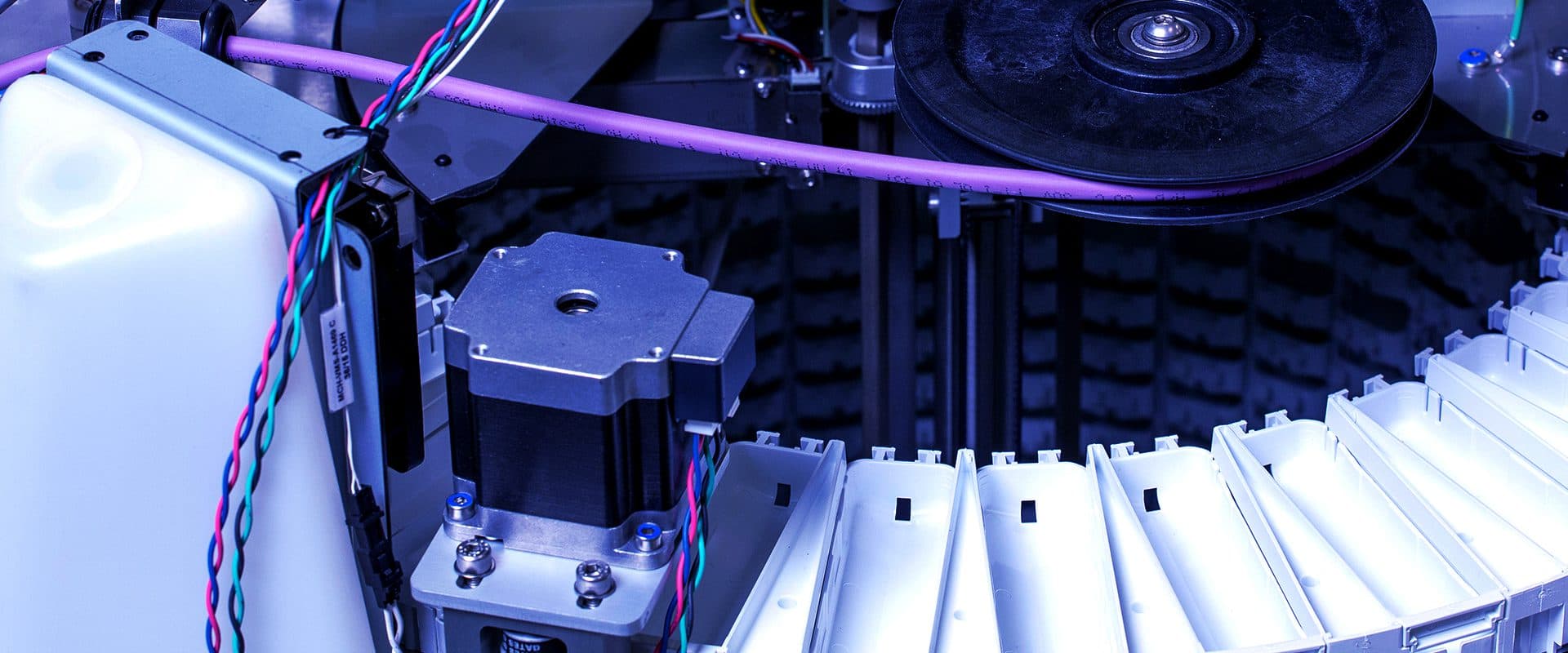
  • Innovative sheet metal design providing a stable, vibration-free environment for sensitive optical modules
  • 3D component evaluation and redesign, which improved performance and reduced production costs

The comprehensive redesign increased monthly production capacity by 8x and achieved zero failures post-implementation, eliminating manufacturing downtime and supporting the company’s growth trajectory.

Why Choose Ascential?

When you engage our team, you tap into 70+ years of experience delivering mission-critical solutions that bridge precision engineering, automation, and medical manufacturing knowledge from 7 highly specialized firms.

Artificial Intelligence Icon

Additive Manufacturing Experience

We design and manufacture commercial platforms across extrusion, SLA, DLP, powder bed fusion, binder jetting, and material jetting. Our team has successfully scaled additive systems at the industry's largest production volumes.

Artificial Intelligence Icon

Integrated Engineering

Resolve production issues quickly and productively. Work with a collaborative team that can simultaneously address challenges in systems engineering, precision motion, thermal, optics, embedded software, and manufacturing.

Artificial Intelligence Icon

Manufacturing at Additive Platform Tolerances

During development, Ascential sets precise tolerance budgets based on the performance of our production processes and designs calibration and test procedures that production technicians can execute reliably.

Frequently Asked Questions

Get answers to common questions about our additive manufacturing capabilities.

We’ve designed and manufactured platforms across multiple additive manufacturing technologies — extrusion, stereolithography, DLP, powder bed fusion, binder jetting, and material jetting. The core engineering disciplines (precision motion, material delivery, thermal management, process control) are consistent across technologies; the subsystem design is specific to each.

We’ve built commercial additive manufacturing platforms for leading companies in the industry. Our engineering leadership includes direct experience developing additive manufacturing systems at the largest production scale in the industry, bringing firsthand knowledge of what it takes to move from prototype to volume production.

We have sites in the U.S., Southeast Asia, Ireland, and Costa Rica. We use U.S. sites for development and pilot builds where engineering proximity matters, and structure volume manufacturing to hit the cost targets the market requires.

Yes. We design calibration, alignment, and final test procedures as part of the platform development — not as an afterthought at transfer. The goal is procedures that production technicians can execute reliably with documented pass/fail criteria, so manufacturing doesn’t depend on the engineering team being on the floor.

A full additive manufacturing platform program typically runs 6-12 months, depending on complexity and technology maturity. Targeted subsystem development or next-generation upgrades are faster. GMP or regulated-environment platforms with additional validation requirements may extend beyond that range.

Either. We routinely integrate client-preferred suppliers for motion components, print heads, lasers, and material-specific hardware. Where you don’t have a preference, we use our qualified supply base. For components that directly drive print quality — motion stages, deposition subsystems, energy sources — we recommend qualifying a second source early.

Related Resources